
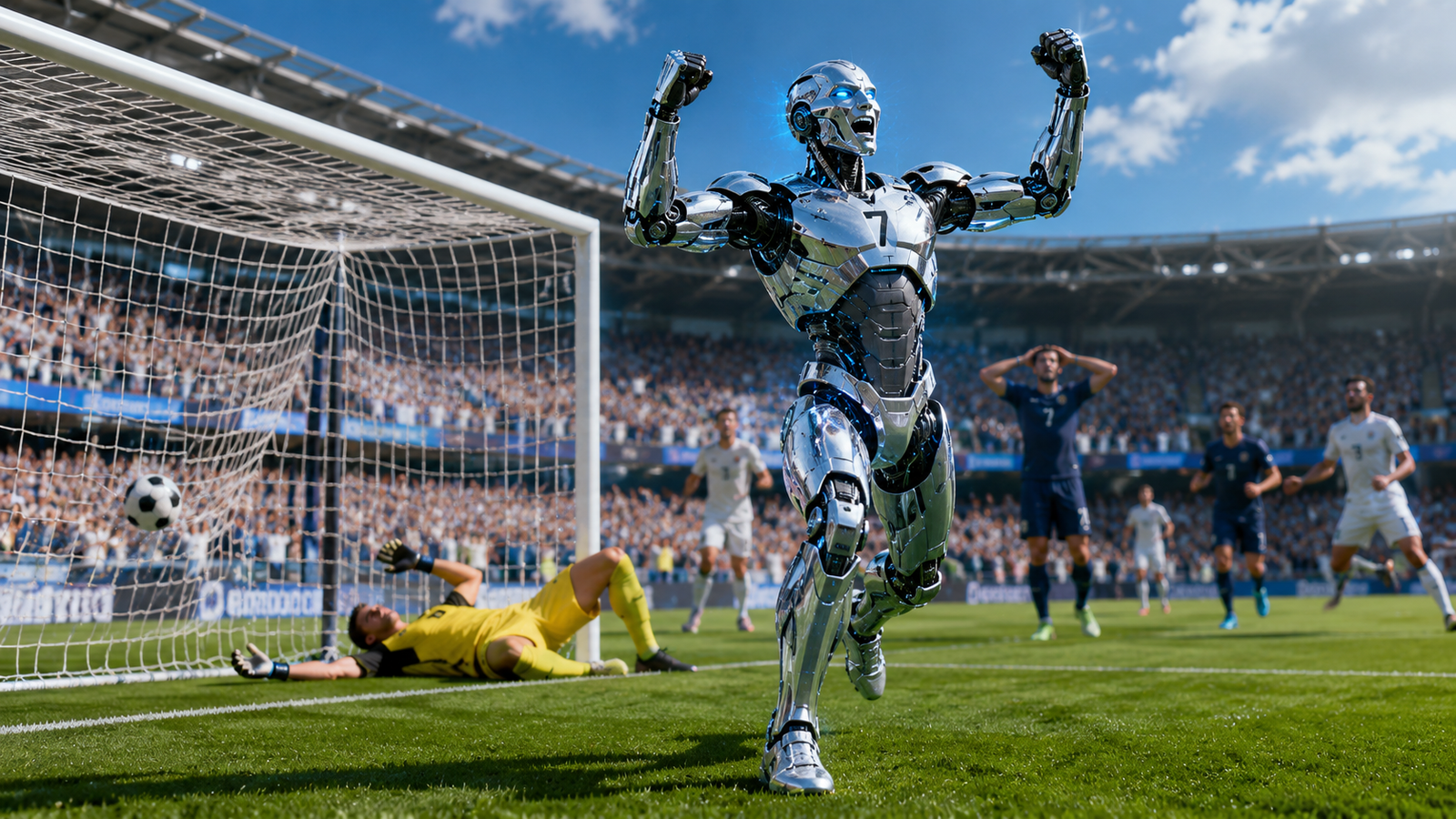
There is a moment in almost every major sporting event — a disputed offside call, a questionable penalty, a line judge’s ruling that changes the outcome of a match — when a significant portion of the watching world simultaneously wonders the same thing: could a machine do this better? The question has moved from idle speculation to serious technological and philosophical debate, and the answer, it turns out, is considerably more complicated than either the enthusiasts or the sceptics tend to acknowledge.
Technology is already embedded in officiating across virtually every major sport. The question is no longer whether machines will assist human referees — they already do, substantially — but whether they will eventually replace them entirely. To answer that question properly, we need to understand what referees actually do, how technology currently performs those functions, and what would be lost — or gained — in a world where the human official disappears from sport altogether.
What Referees Actually Do?
It is easy to reduce refereeing to a series of binary decisions: in or out, foul or no foul, offside or onside. Viewed through that lens, machines seem obviously superior. They do not get tired. They do not have unconscious biases. They do not feel the pressure of 80,000 fans screaming for a decision. They process visual information faster than the human eye and with greater precision.
But officiating is not merely a series of binary decisions. It is a continuous act of judgment that involves reading the flow of a game, managing the psychology of players and coaches, making contextual decisions that balance the letter of the rules against the spirit of the contest, and — perhaps most importantly — communicating those decisions in a way that maintains the authority and momentum of the event.
A referee who awards every technical foul in a basketball game without considering whether a call would unduly disrupt an otherwise flowing contest is not being a good referee — they are being a machine. The best officials in every sport understand that their role involves discretion, context, and a kind of emotional intelligence that current artificial intelligence systems cannot replicate.
This distinction matters enormously in any serious discussion about robotic officiating.
What Technology Already Does?
Before speculating about the future, it is worth taking stock of how comprehensively technology has already transformed officiating in the present.
- Football (Soccer): The Video Assistant Referee system reviews goals, penalties, red cards, and cases of mistaken identity. Goal-line technology determines instantaneously whether the ball has crossed the line. Semi-automated offside technology, deployed at the 2022 World Cup, uses multiple high-frequency cameras and player-tracking algorithms to calculate offside positions in seconds with millimetre precision — far beyond what any human linesman could achieve with the naked eye.
- Tennis: Hawk-Eye ball-tracking technology has been used in professional tennis since 2006, providing definitive rulings on line calls that players can challenge. At Wimbledon 2023 and subsequently at other major tournaments, electronic line calling has replaced human line judges entirely for certain decisions — a significant moment in the history of officiating.
- Cricket: The Decision Review System combines ball-tracking, ultra-edge sound detection, and thermal imaging to assist umpires in reviewing decisions on LBW calls, caught-behind appeals, and front-foot no-balls. The technology has substantially reduced the rate of incorrect decisions and has fundamentally changed how players and captains engage with the officiating process.
- American Football: Instant replay review has been part of NFL officiating for decades, allowing officials to review key decisions against video evidence. The league has also introduced automated ball-spotting systems and is actively developing technology to reduce reliance on human judgment in specific areas.
- Athletics: Sprint finish cameras capable of capturing thousands of frames per second have made photo finishes definitive in ways that human judges simply cannot match. Timing systems are fully automated. Wind gauges, false-start detection, and field event measurement are all handled by technology.
The pattern is clear: in areas where precision measurement is the primary requirement — ball position, timing, distance — technology has already largely replaced human judgment, and the results are unambiguously better. The debates now centre on the more complex, interpretive aspects of officiating.
The Case for Robotic Referees
The argument for full automation of officiating is strongest in sports where decisions are primarily factual rather than interpretive, and where the stakes of error are highest.
- Consistency is the most compelling argument. Human referees are inconsistent — not because they are incompetent, but because they are human. Research across multiple sports has documented home advantage effects on officiating, unconscious bias toward higher-status players and teams, fatigue effects in the late stages of matches, and the well-documented tendency for officials to be influenced by crowd noise and intensity. An automated system would make the same call in the same situation every time, regardless of the scoreline, the crowd, or the reputation of the players involved.
- Speed is another significant advantage. In sports where moments matter — the question of whether a shot was in or out, whether a player was offside by a fraction of a centimetre — human reaction time and visual processing are simply inferior to what sensors and algorithms can deliver. The semi-automated offside system in football has reduced the time needed for offside decisions from several minutes to under a minute, with greater accuracy.
- Reduced conflict is a less obvious but genuine benefit. Much of the conflict between players, coaches, and officials in modern sport stems from the belief — often correct — that human officials make mistakes. The spectacle of players surrounding a referee, of managers being sent to the stands for protesting decisions, of post-match press conferences dominated by officiating controversies — all of this is driven partly by the fallibility of human judgment. Systems that remove ambiguity from factual decisions genuinely reduce conflict.
- Scalability is also relevant. Professional sport has the resources to employ highly trained human officials. Youth sport, amateur competition, and lower-level professional leagues often do not. Automated officiating systems, once developed, can be deployed at scale in ways that human officiating cannot, potentially raising the quality and consistency of decision-making across the entire sport ecosystem.
The Case Against
The counter-arguments are equally substantial, and in some respects more fundamental.
- The interpretive problem is the most significant. Many of the most consequential decisions in sport are not factual — they are matters of judgment. Was that a genuine attempt to play the ball, or was it a deliberate foul? Was that physical contact part of the normal contest, or was it dangerous play deserving of a red card? Did that player dive to win a penalty, or was the contact sufficient to justify the award? These questions do not have algorithmic answers. They require contextual judgment that current AI systems are nowhere near capable of providing.
- The rules problem compounds this. The rules of most sports were written by humans for humans, with the implicit assumption that they would be interpreted by humans with discretion and common sense. When rules are applied with literal, mechanical precision by a system incapable of discretion, they often produce outcomes that are technically correct but contextually absurd. The ongoing controversy about handball decisions in football — where the ball striking a player’s arm in a physically impossible-to-avoid position is technically a handball under the rules — is a perfect example of what happens when mechanical rule application replaces human judgment.
- The human drama problem is one that technology advocates tend to underestimate. Sport is not just a competition — it is a narrative, and officials are part of that narrative. The controversial decision, the disputed call, the moment of injustice that fuels a team’s determination — these elements are not bugs in the system of sport. They are features. They generate conversation, debate, passion, and the kind of emotional engagement that keeps fans invested across years and decades. A fully automated officiating system would produce more accurate decisions and far less drama.
- The accountability problem is also significant. When a human referee makes a wrong call, there is someone to hold accountable — someone who can explain their reasoning, who can learn from their mistake, who can be retrained or, in extreme cases, removed from the role. When an algorithm makes a wrong call, accountability is diffuse and opaque. Who is responsible — the programmer, the governing body, the hardware manufacturer? How does the system explain its decision to a player who believes it was wrong? How does it respond to the entirely legitimate human desire for explanation and acknowledgment?
Hybrid Systems: The Most Likely Future
The realistic trajectory for officiating in most sports is not full automation but increasingly sophisticated hybrid systems — human officials supported by technology that handles the factual elements of decision-making while retaining human judgment for the interpretive elements.
This model already exists in multiple sports and is maturing rapidly. The most plausible near-future development is a system in which all factual questions — ball position, timing, physical contact threshold, player location — are handled automatically in real time, while a human official retains responsibility for the interpretive decisions: whether conduct was dangerous, whether intent was present, whether the spirit of the rules was violated.
This hybrid approach captures most of the accuracy benefits of automation while preserving the human judgment that the interpretive elements of officiating genuinely require. It also preserves human accountability and the dramatic potential of officiating decisions that remains an integral part of sport’s appeal.
Sport by Sport: Where Are We Headed?
The answer to the question of robotic referees is not uniform across sports. In tennis, the transition is already largely complete for line calls — and the sport has not collapsed. In cricket, the DRS has been absorbed into the culture of the game. In athletics, timing and measurement have been automated for decades.
Football is the most complex case, because its rules are the most interpretive and its culture is the most resistant to change. Full automation of football officiating is a distant prospect at best. The more likely scenario is continued refinement of VAR and automated offside, with human referees remaining central to the game for the foreseeable future.
American football, by contrast, is culturally more receptive to technological intervention and has specific, well-defined decisions that are strong candidates for full automation.
Basketball, with its continuous action and the enormous volume of potential foul calls in any given game, presents the greatest challenge to automation — the judgment calls are too numerous and too contextual for current technology to handle.
The Question Behind the Question
Ultimately, the debate about robotic referees is a debate about what sport is for. If sport is a precision competition in which outcomes should be determined entirely by the athletes’ performances, with human error in officiating representing an unfortunate contamination of that process, then automation is unambiguously desirable.
If sport is a human drama — messy, contested, occasionally unjust, but ultimately richer for its imperfection — then the human referee, fallible as they are, remains an essential part of the story.
Most serious observers of sport hold both of these views simultaneously, which is why the debate is so persistent and so interesting. Technology will continue to improve the accuracy of officiating decisions, and that is genuinely good. But the wholesale replacement of human officials — across all sports, for all decisions — would change the nature of sport in ways that go well beyond the scoreline.
The robot referee is coming. But it is coming as a colleague, not a replacement. And in the most human moments of the most human games, the person with the whistle will still be a person.