
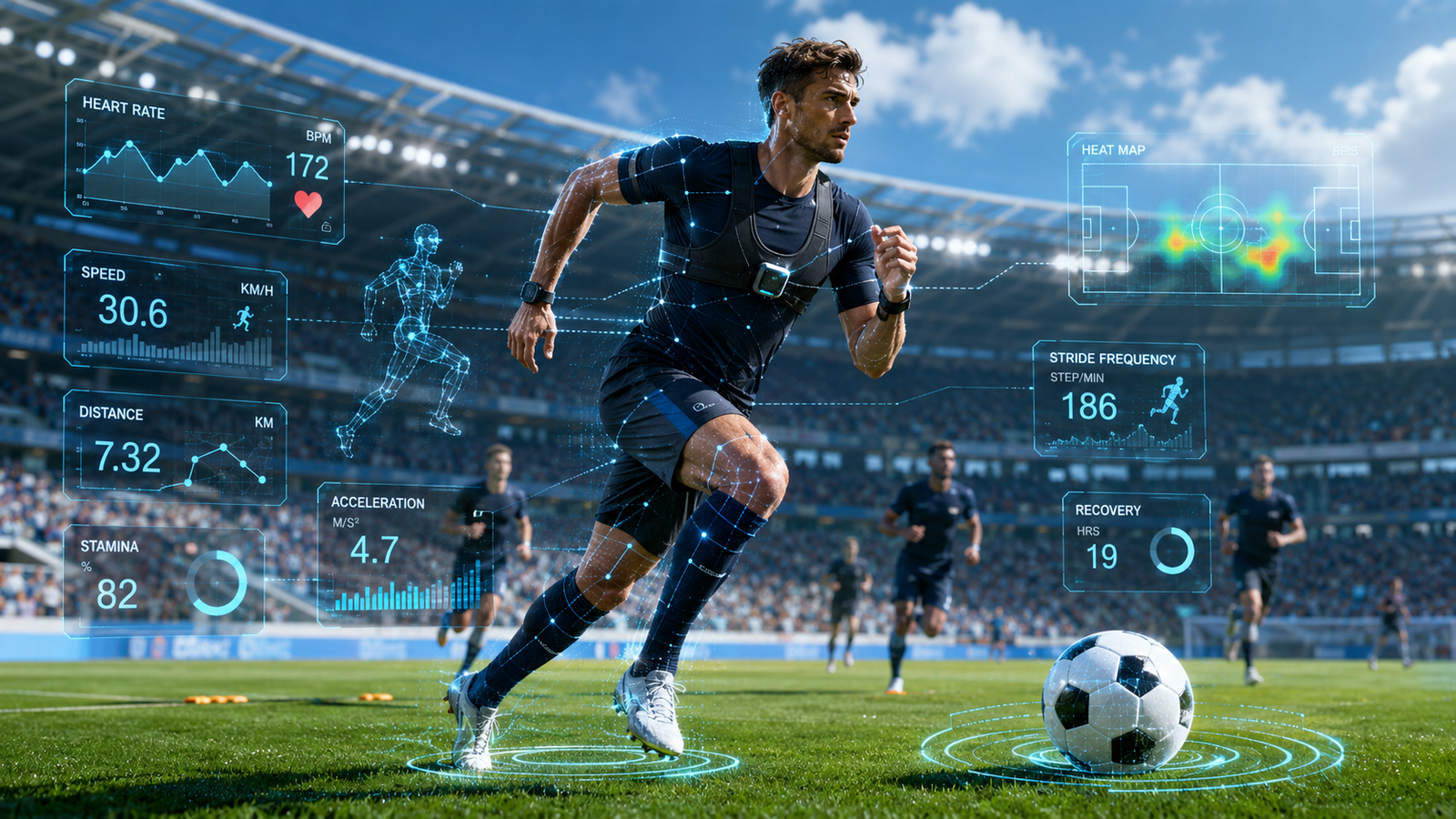
A decade ago, a GPS vest worn during training was considered cutting-edge technology. Today, professional athletes are monitored by ecosystems of interconnected devices that track everything from muscle oxygen levels to sleep quality to the precise biomechanical load on a specific tendon during a sprint.
Wearable technology has moved from novelty to necessity in professional sport. It is now embedded in the daily routines of elite athletes across football, basketball, rugby, tennis, cycling and virtually every other major discipline — and its influence on how athletes train, recover and compete has been profound.
This is the complete guide to wearable technology in professional sports: what it measures, how it is used, and where it is taking the industry.
What Is Wearable Technology in Sport?
Wearable sports technology refers to any device worn on or close to the body that collects, transmits or analyses physiological and biomechanical data. The category is broad and growing rapidly — it includes GPS tracking vests, heart rate monitors, smartwatches, smart clothing embedded with sensors, mouthguards that measure head impacts, and patches that analyse sweat composition in real time.
What unites all of these devices is their ability to generate continuous, objective data about an athlete’s body and movement — data that can be used to optimise training, prevent injury, accelerate recovery and inform tactical decisions.
The global sports wearables market was valued at over $4 billion in 2024 and is projected to exceed $8 billion by 2028, driven by falling sensor costs, improving battery life, advances in miniaturisation and growing demand from professional sports organisations worldwide.
GPS and Movement Tracking: The Foundation
The most widespread wearable technology in professional team sport is GPS tracking — small devices worn in a vest between the shoulder blades that record position data multiple times per second.
From this positional data, analysts can extract an enormous range of performance metrics: total distance covered, high-speed running distance, sprint count and duration, acceleration and deceleration events, and maximum speed reached. Over time, this data builds a detailed picture of each player’s physical output — their baseline levels, their peaks, and crucially, their patterns of fatigue.
In the Premier League, Bundesliga and other top football leagues, GPS data is collected at every training session and match. Fitness coaches use it to manage individual player loads — ensuring that players are trained hard enough to maintain peak fitness without accumulating the kind of fatigue that leads to soft tissue injuries.
The practical impact is significant. Research consistently shows that a substantial proportion of hamstring injuries in football are preceded by periods of excessive sprint loading. GPS data allows fitness staff to identify when a player is approaching that threshold and intervene — reducing training intensity, adjusting session design or resting a player — before the injury occurs.
Modern GPS systems used by elite clubs can track position at up to 18 times per second with sub-metre accuracy, and the vests that house them weigh less than 50 grams. Players barely notice they are wearing them.
Heart Rate and Physiological Monitoring
GPS data tells you what a player did physically. Heart rate and physiological monitoring tells you how their body responded to it — and the difference between those two things is where much of the most valuable performance insight lives.
Heart Rate Variability
Heart rate variability (HRV) — the variation in time between consecutive heartbeats — has emerged as one of the most powerful indicators of an athlete’s readiness to train and compete. A high HRV generally indicates that the nervous system is well-recovered and the athlete is prepared for high-intensity work. A low HRV suggests fatigue, stress or inadequate recovery.
Elite sports organisations now collect HRV data from players every morning using chest straps or wrist-based monitors, feeding it into readiness models that help coaches make informed decisions about training intensity. If a key player shows a significantly depressed HRV on the morning of a heavy training day, the coaching staff can adjust their programme accordingly — protecting long-term health while maintaining overall squad fitness.
Muscle Oxygen Monitoring
Devices like the Moxy Monitor use near-infrared spectroscopy to measure the oxygen saturation of muscle tissue in real time. This gives coaches and athletes a direct window into how efficiently muscles are being supplied with oxygen during exercise — information that is particularly valuable for endurance athletes and in sports with intermittent high-intensity demands like football and basketball.
Muscle oxygen data can identify thresholds beyond which performance drops sharply, enabling more precise training zone calibration than heart rate alone can provide.
Smart Clothing and Embedded Sensors
The next frontier of wearable sports technology is moving beyond discrete devices toward clothing that is itself the sensor — garments with conductive fibres and embedded sensors woven directly into the fabric.
Companies like Catapult, Hexoskin and Athos produce smart compression garments that can measure muscle activation patterns, respiratory rate, breathing volume and postural data continuously during training and competition. Unlike traditional wearables, smart clothing distributes sensors across the entire body, enabling full-body biomechanical analysis without the encumbrance of multiple separate devices.
For rehabilitation, smart clothing has been particularly transformative. Athletes recovering from injury can wear sensor-embedded garments that monitor movement asymmetries — subtle differences in how they use the injured versus the uninjured limb — giving physiotherapists objective data to guide return-to-play decisions rather than relying solely on subjective assessments.
Rugby union has been an early adopter of smart clothing technology, with several international squads using full-body sensor garments during training camps to monitor the physical demands of contact training in detail that GPS alone cannot capture.
Wearables for Sleep and Recovery Monitoring
Performance in sport is not built only during training — it is built during recovery. Sleep, in particular, is the single most powerful recovery tool available to athletes, and wearable technology has made monitoring sleep quality practical at scale.
Devices like the WHOOP strap, Oura Ring and Polar H10 collect continuous data on sleep duration, sleep stage distribution (deep sleep, REM sleep, light sleep), resting heart rate and HRV throughout the night. This data is synthesised into recovery scores that athletes and coaches can review each morning.
The NBA has been particularly progressive in its approach to sleep monitoring. Several franchises — including the Golden State Warriors and Phoenix Suns — have integrated sleep tracking into their player wellness programmes, using the data to schedule practices, manage travel itineraries and identify players who are chronically underrecovering.
The results align with what sleep science research would predict. Players with consistently high sleep quality scores show better reaction times, higher shooting percentages and lower injury rates. Those with disrupted sleep patterns are flagged for intervention — whether that means adjusting training schedules, addressing travel-related sleep disruption or providing support for underlying sleep disorders.
For endurance sports like cycling and marathon running, sleep and recovery monitoring has become almost universal at the elite level. Tour de France teams use continuous recovery monitoring to manage the extraordinary physical demands of a three-week stage race, adjusting nutrition, training load and schedule in real time based on each rider’s individual recovery data.
Impact and Collision Monitoring
In contact sports — American football, rugby union, rugby league, ice hockey, boxing — monitoring the physical impacts that athletes absorb is a matter of both performance and safety.
Wearable impact sensors, typically embedded in mouthguards, helmets or behind-the-ear devices, measure the magnitude and direction of every head impact an athlete experiences during training and competition. This data serves two critical functions: identifying athletes who have absorbed potentially concussive impacts in real time, and building longitudinal data on cumulative head impact exposure over a career.
Smart Mouthguards
The smart mouthguard has become one of the most significant innovations in contact sport safety. Devices developed by companies like Prevent Biometrics and the Stanford-Riddell collaboration contain tri-axial accelerometers and gyroscopes that measure linear and rotational head acceleration with every impact.
Data is transmitted wirelessly to sideline tablets in real time, enabling medical staff to identify impacts that exceed concussion thresholds immediately — rather than relying on players to self-report symptoms or coaches to notice behavioural changes during play.
World Rugby has been trialling smart mouthguard technology at elite level and the data generated is already influencing both playing regulations and coaching approaches to contact training load.
Wearables During Competition: Challenges and Innovations
While wearable technology has become ubiquitous in training environments, competition presents unique challenges. Many sports governing bodies either restrict or prohibit wearable devices during official competition — the Premier League, for example, does not allow GPS vests during matches, and tennis’s ITF has strict rules on what players can wear on court.
The sports technology industry has responded by developing devices that are smaller, less visible and harder to detect — as well as working with governing bodies to establish approved device lists that allow certain wearables in competition settings.
In cricket, the ICC has approved the use of heart rate monitors during matches. In cycling, power meters have been standard in competition for decades. In swimming, FINA permits certain sensor technologies that can be embedded in swimsuits. The regulatory landscape is evolving, and the direction of travel is clearly toward greater acceptance of performance-monitoring technology in competition.
Data Privacy and Athlete Rights
The rapid expansion of wearable technology in professional sport raises important questions about data ownership, privacy and athlete rights that the industry is only beginning to grapple with seriously.
When a club collects GPS, heart rate and sleep data from its players, who owns that data? Can it be shared with third parties? Can it be used in contract negotiations — for example, to argue that a player’s physical output has declined? Can it be sold to betting companies or broadcasters?
These are not hypothetical concerns. Several high-profile disputes between professional athletes and clubs have centred on the use of biometric data, and players’ unions in multiple sports have pushed for explicit data rights protections in collective bargaining agreements.
The NFL Players Association and the NBA Players Association have both negotiated agreements that give players ownership of their biometric data and restrict how clubs can use it. Similar protections are being developed in football through FIFA and national player associations.
As wearable technology becomes more invasive — monitoring not just physical output but biochemistry, hormonal states and psychological indicators — the ethical framework governing its use will need to keep pace with its capabilities.
The Future of Wearable Technology in Sport
The next generation of sports wearables is moving toward continuous, non-invasive monitoring of biochemical markers — the kind of real-time physiological intelligence that currently requires blood tests and laboratory analysis.
- Sweat analysis patches — Devices like the Gatorade Gx Sweat Patch already analyse sweat composition in real time, measuring sodium loss, sweat rate and hydration status during exercise. Next-generation versions will monitor glucose, lactate, cortisol and other biomarkers that provide a detailed picture of metabolic state during training and competition.
- Continuous glucose monitoring — CGM devices, originally developed for diabetes management, are being adopted by endurance athletes to monitor blood glucose in real time during training. Understanding how an athlete’s glucose levels respond to different training intensities enables much more precise nutrition and fuelling strategies.
- Neural and cognitive monitoring — Emerging devices are beginning to monitor brain activity and cognitive state during sport. EEG headbands that measure focus, arousal and mental fatigue are being trialled in archery, golf and shooting sports — disciplines where the mental component of performance is as important as the physical.
- Miniaturisation and integration — Future wearables will be smaller, less intrusive and more fully integrated with each other and with AI analysis platforms. The vision of a unified athlete monitoring ecosystem — where every relevant physiological variable is tracked continuously and synthesised into actionable insights in real time — is moving from concept to reality.
Conclusion
Wearable technology has already transformed professional sport in ways that would have seemed remarkable just a decade ago. Athletes are healthier, better prepared and more physically optimised than any previous generation — and wearable devices have played a central role in that transformation.
But the technology is still in its early stages. The next wave of innovation — biochemical monitoring, neural sensing, AI-powered real-time coaching — promises to push the boundaries of athletic performance further still.
For sports organisations, the challenge is no longer access to data. It is developing the analytical capability, the coaching culture and the ethical frameworks to use that data wisely — in the service of athletic performance, athlete welfare and the integrity of sport.
The athletes of the future will not just train harder. They will train smarter, informed by a continuous stream of objective data about their own bodies that previous generations could only dream of.